Ishihara-style plates, a three-axis severity slider, and month-by-month tracking you can show your eye doctor.
Download on theApp Store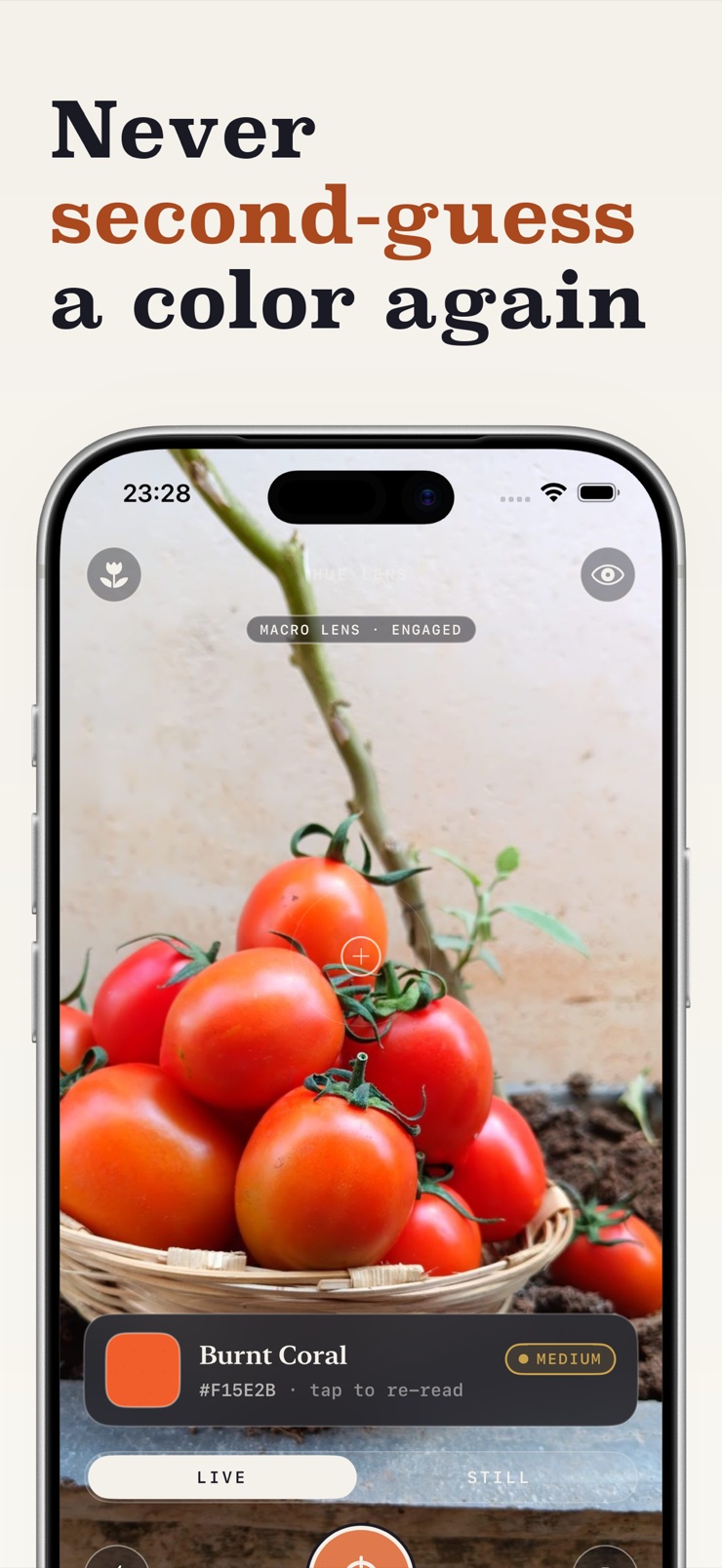
HueLens is a color-vision self-test built for the way red-green color vision deficiency actually works — three axes, not one rigid type. A daily Ishihara-style plate test takes about two minutes, and the plates are procedurally drawn so they are fresh every time.
Answer what you see and HueLens scores it and charts your result over months, so you have a real history to show at an eye appointment instead of a single impression. When you are not sure, "I don't see a number" is always an honest answer — no shame, no guessing pressure.
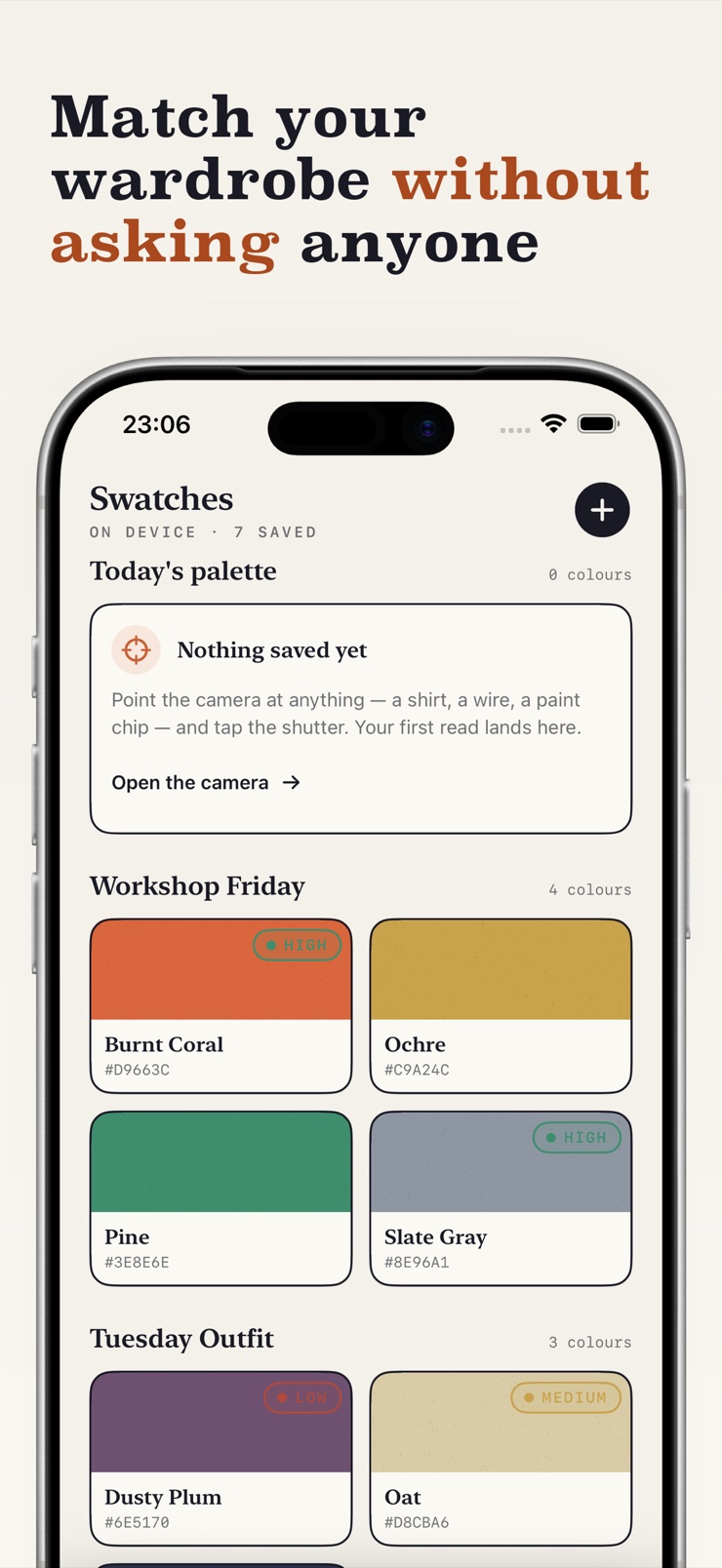
Beyond the test, HueLens works as an everyday aid: point the camera at anything, tap, and read the color name with its exact hex value, or use the live preview to see the same scene the way full-color vision sees it. Everything runs on your iPhone; nothing is uploaded anywhere. HueLens does not diagnose color vision deficiency and is not a substitute for a professional eye exam.
An Ishihara-style color vision test in about two minutes, procedurally drawn so the plates never repeat from memory.
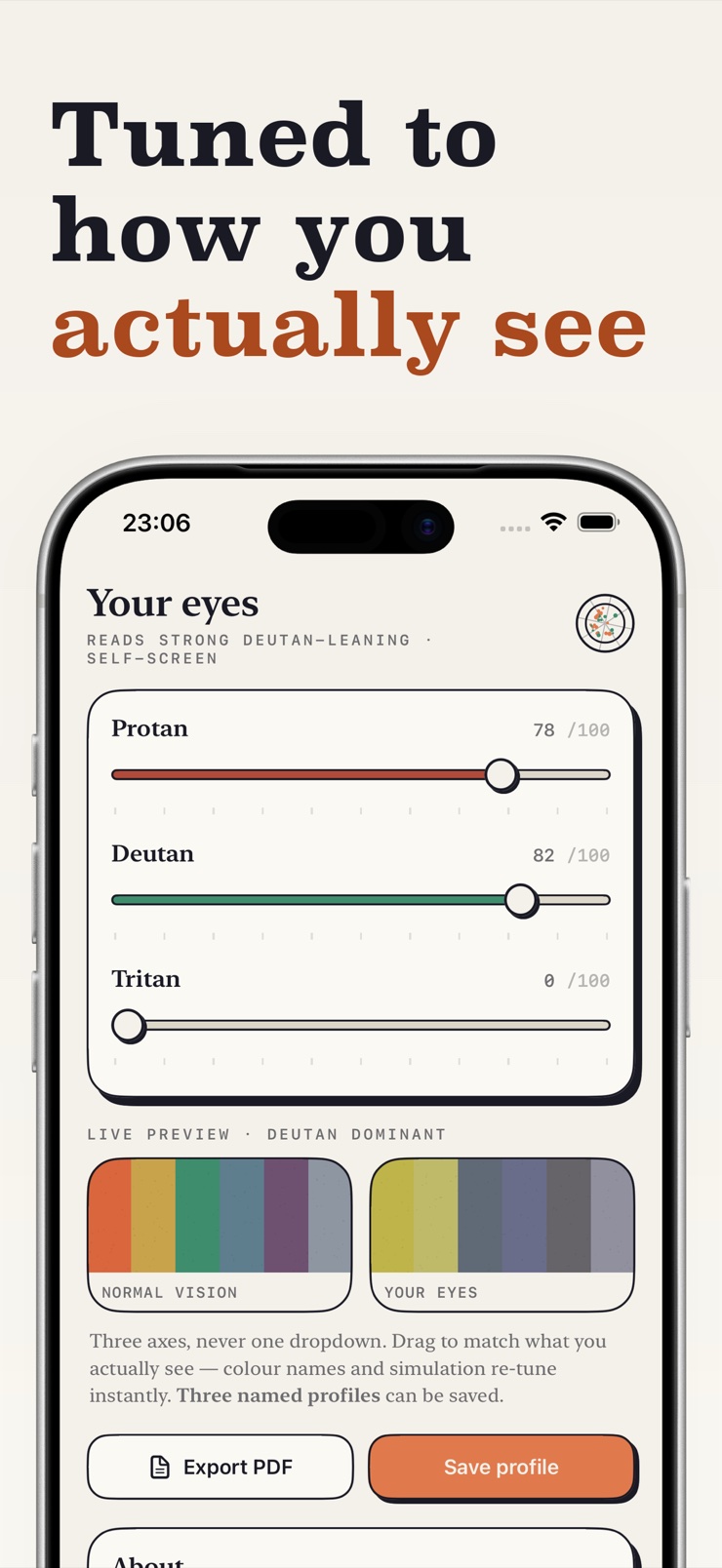
Tune protan, deutan, and tritan sensitivity together — matched to your eyes, not a rigid textbook type.
A live preview shows the same scene or swatches the way full-color vision sees them, side by side with your view.
Point the camera at a sweater, a cable, or a paint chip, tap, and read the color name and exact hex value — with an honest confidence note.
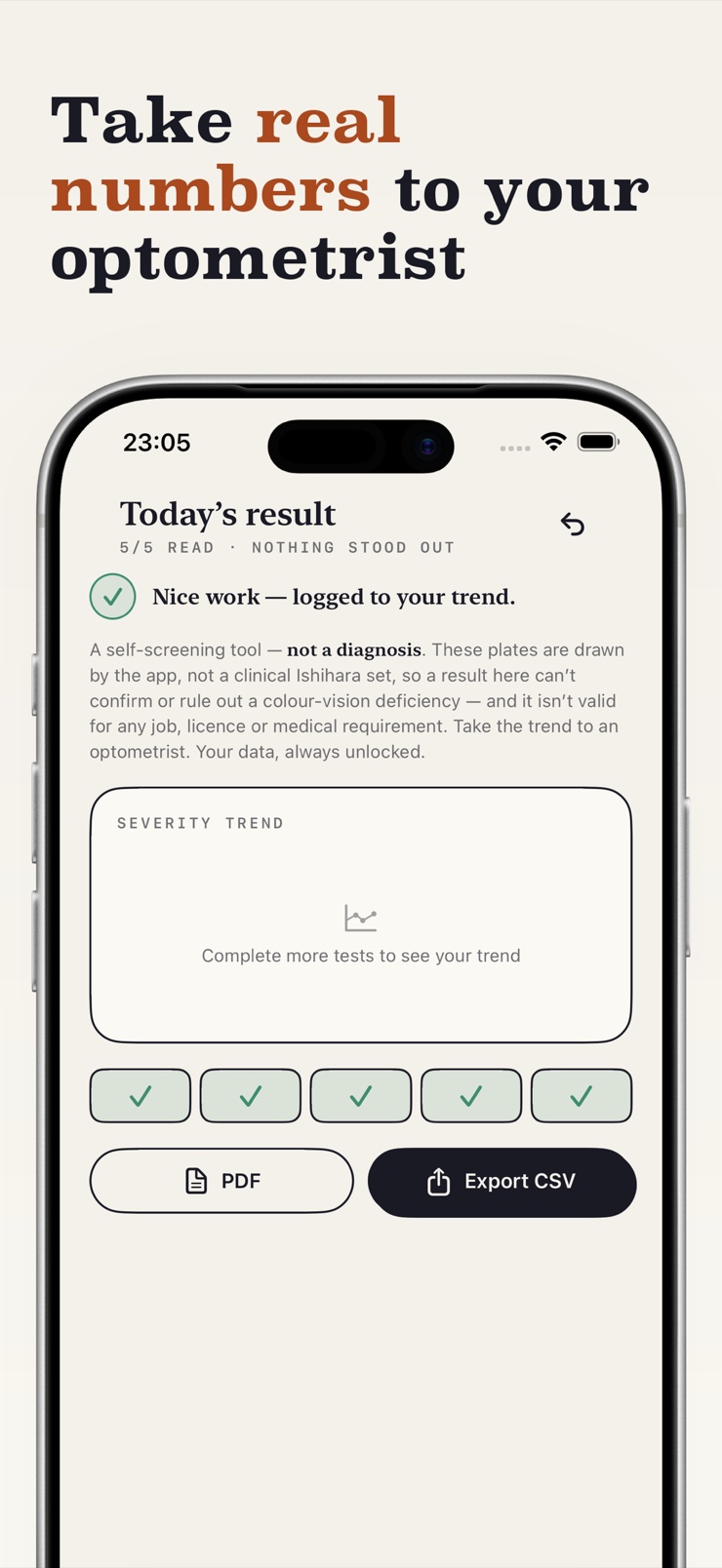
Your results are charted over months, so you can watch your color vision over time instead of guessing from one test.
Months of scored self-tests in one chart, ready to pull up on your phone at an eye appointment.
Work through a short run of Ishihara-style plates and answer what you actually see — including "I don't see a number."
Adjust the three-axis severity slider until the app's picture of your color vision matches your experience.
Each test lands on a chart that builds up over weeks and months.
Open the chart at your appointment and give your eye doctor real data instead of a guess.
The standard screening is a plate test: numbers or shapes hidden in dot patterns that separate typical color vision from red-green deficiency. HueLens puts an Ishihara-style version of this on your iPhone, takes about two minutes a day, and scores each run. A formal diagnosis still requires an eye doctor, and HueLens is built to prepare you for that visit, not replace it.
It is the classic screening test made of circular plates filled with colored dots, where a number is visible to some kinds of color vision and invisible to others. HueLens draws its plates procedurally in the same style, so each day's test is fresh and cannot be memorized. You answer what you see and the app scores the pattern of your responses.
They are the three axes of color vision deficiency: protan affects the red-sensing cones, deutan the green-sensing cones, and tritan the blue-sensing ones. Real vision often sits between textbook types, which is why HueLens uses a three-axis severity slider that tunes all three together instead of forcing you into one rigid label.
A phone can screen it usefully: modern iPhone displays render the color differences plate tests depend on, and an app can track results far more consistently than a one-off chart on a wall. HueLens is honest about the limits — it is a self-screening and tracking tool, and it tells you plainly that it does not diagnose.
They vary widely — many are single-shot, unscored, and rendered without care for color accuracy. A better signal comes from repeated, consistent testing over time, which is what HueLens is designed around: the same style of test, scored the same way, charted over months. For a definitive answer, see an eye care professional.
Inherited red-green deficiency is generally stable, but acquired changes can happen with age, medication, or certain eye conditions — and those changes are worth catching. Because HueLens charts your daily results over months, a drift in your scores becomes visible instead of anecdotal, and you have the history on hand for your doctor.
Yes. HueLens turns the iPhone camera into a color reader: point it at a sweater, a cable, or a paint sample, tap, and it names the color and gives the exact hex value. It measures a small area under your finger, compensates for the light, and adds an honest confidence note — when it is unsure, it says so instead of guessing.
Most people with red-green deficiency see plenty of color — but certain pairs, like red versus brown or green versus orange, collapse toward each other. HueLens can show this in both directions: a live preview displays the same scene the way full-color vision sees it, right next to your own view, which is also a powerful way to show family and friends what the difference actually is.
A record of what you have noticed and when helps a lot, since an exam is a single point in time. HueLens builds that record for you: months of scored self-tests in one chart you can pull up and talk through at the appointment.
No. HueLens is an everyday accessibility aid and a personal screening tool — it scores plate-style self-tests and tracks trends, but a diagnosis of color vision deficiency requires a professional eye exam. The app states this honestly and is designed to make that professional visit more productive.
Yes. Everything runs on your iPhone — the tests, the scoring, the charts, and the camera color reading. Nothing is uploaded anywhere, and there is no account. Your results stay on your phone.
The test itself tells you where your color vision is weakest, and that knowledge alone prevents many mismatches. For day-to-day decisions, HueLens's camera reader is the practical tool: tap the shirt and the trousers, read both color names, and know whether they match before you leave the house.
Two minutes a day, and you will know how you really see.
Download on theApp Store