
Write down what you noticed after a date, tag it your way, and watch your own patterns emerge over time — never a verdict.
Download on theApp Store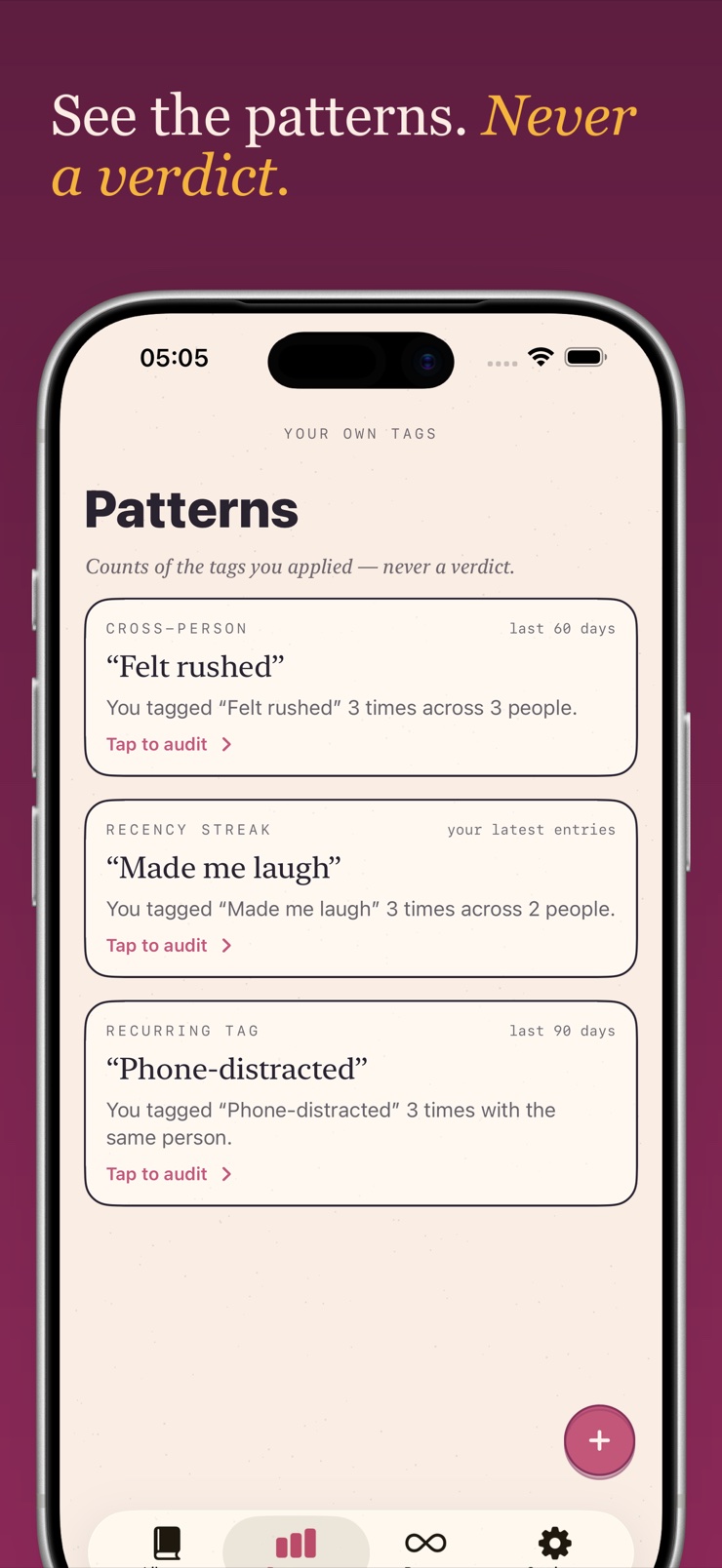
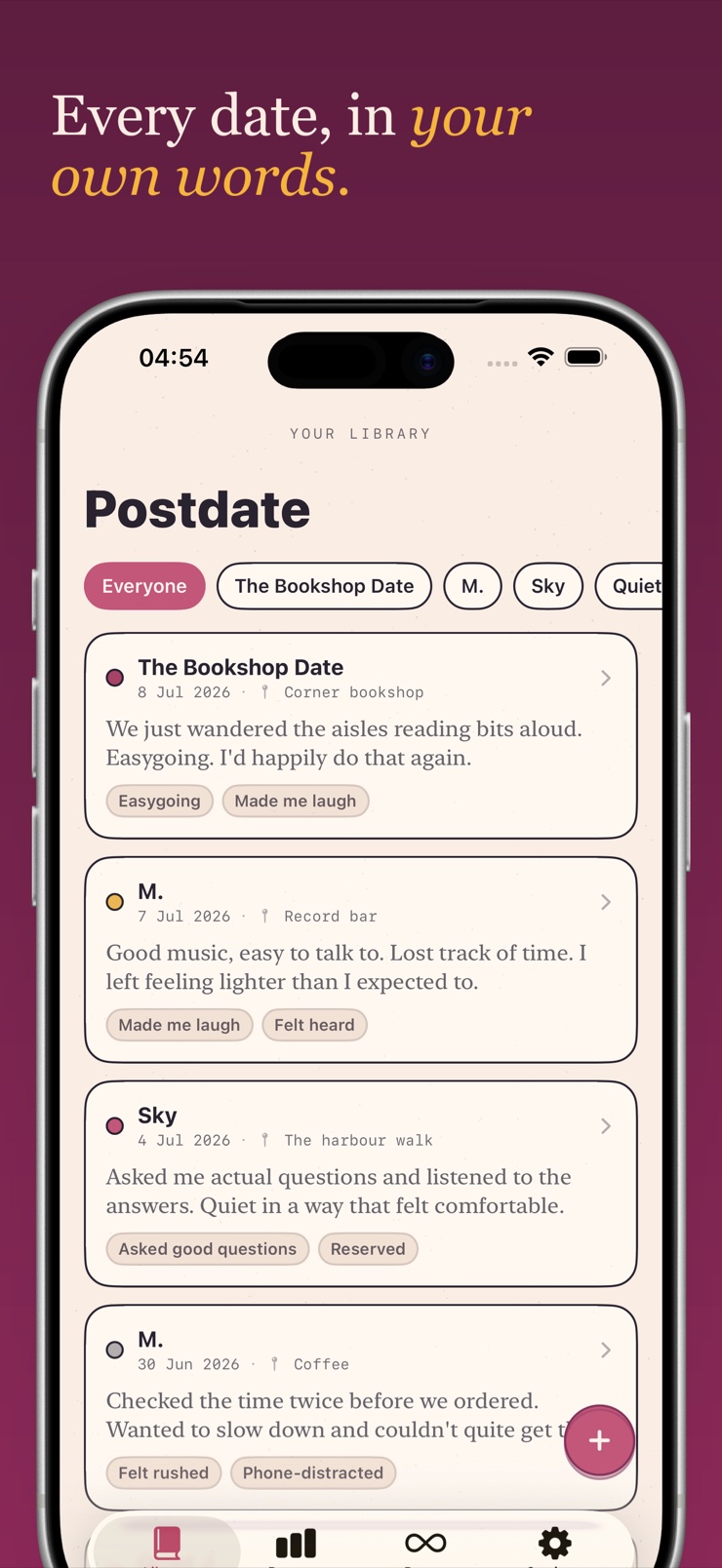
Postdate is a quiet, private place to write down what you noticed after a date. It lives entirely on your device — no account, no login, nothing uploaded anywhere unless you turn on iCloud sync yourself. Your words, your tags, your own patterns.
Instead of judging anyone, Postdate simply counts what you tagged. Bring your own tags or start from a neutral set you can rename or hide, then watch patterns build across your entries as plain tag counts — never predictions, never a diagnosis. Tap any pattern to see exactly which entries it came from, then edit or delete them.
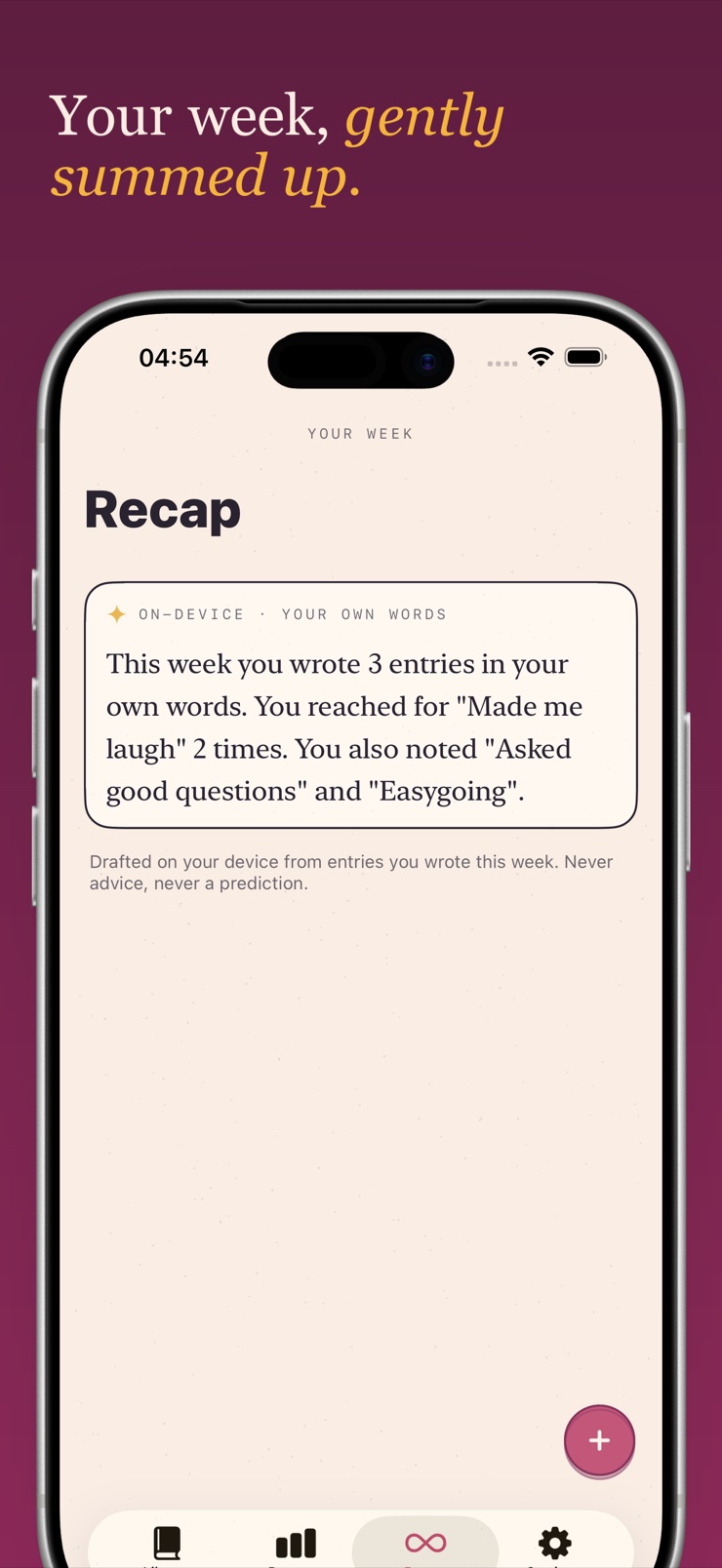
Once a week, an on-device recap drafts a short summary in your own words, so journalling pays you back without any analysis of anyone else's chats or photos. Postdate never tells you a person is good or bad; it shows what you wrote and how often, and leaves the meaning to you.
Every date gets an entry in your own words. The journal lives on your device with no account and no login.
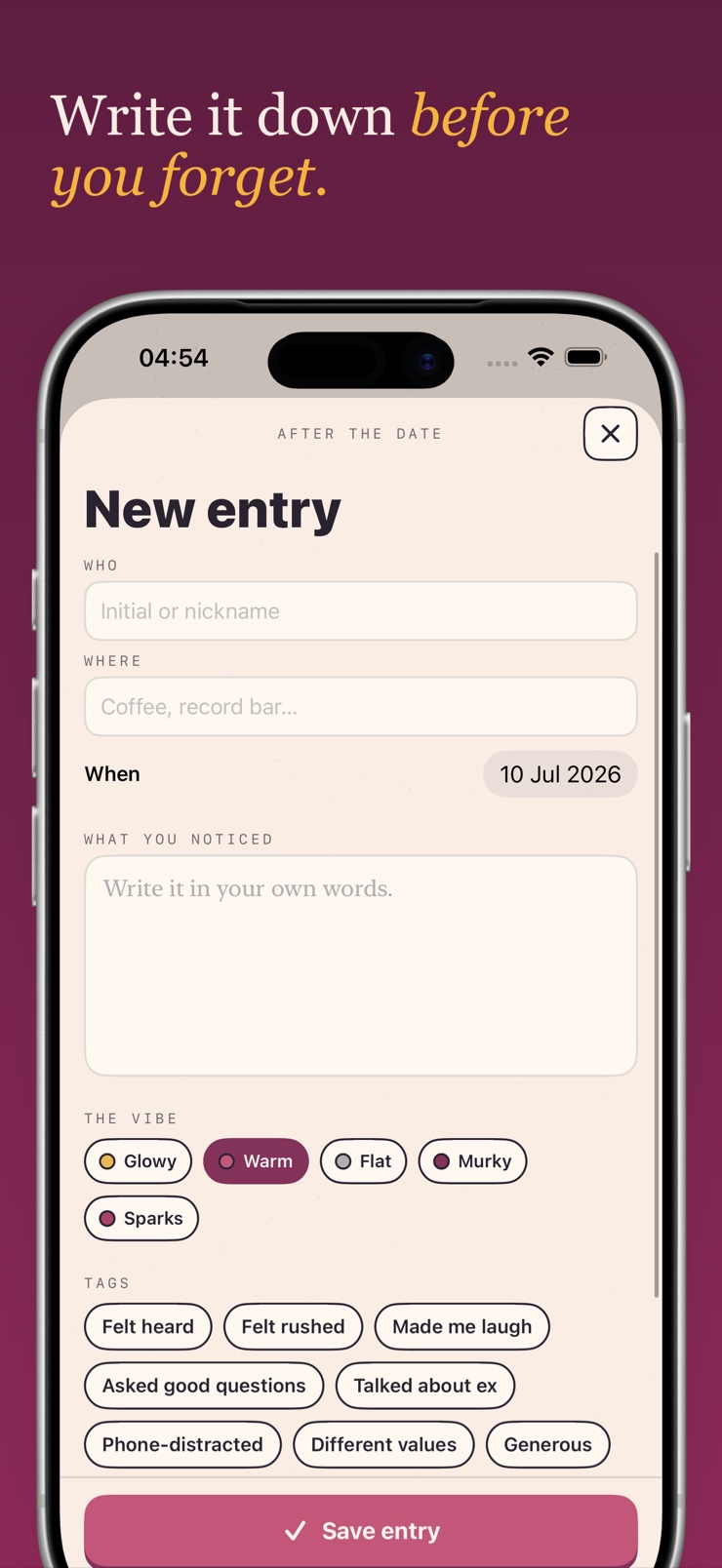
Bring your own tags — red flags, green flags, anything — or start from a neutral set you can rename or hide.
Patterns are shown as your own tag counts across entries, never as predictions or scores about a person.
Tap any pattern to see exactly which entries produced it, then edit or delete them.
A short weekly summary is drafted from your own words, entirely on the device.
Sync between your own devices if you want it. It is off by default, and nothing else ever leaves your phone.
Open Postdate on the way home and capture what you noticed while it's fresh — a few lines is enough.
Attach your own tags to the entry: the things that delighted you, the things that gave you pause.
Over weeks, Postdate counts your tags across entries so recurring themes become visible — as your data, not a verdict.
A weekly on-device recap sums up what you wrote, so you can decide what it means.
Yes. Postdate is a private dating journal where you write what you noticed after each date and tag it with your own labels — red flags, green flags, or anything else. Over time it counts those tags across entries so recurring patterns become visible. It never scores or judges a person; it only reflects what you yourself recorded.
A simple habit works best: shortly after a date, write a few honest lines about what you noticed — how you felt, what stood out, anything that gave you pause. In Postdate you then attach tags to the entry, and the app keeps everything in one private library you can revisit, edit, or delete at any time.
No app can reliably judge another person, and Postdate deliberately doesn't try. It gives you no verdicts, predictions, or compatibility scores. What it does is show how often your own tags recur across your own entries — so if you keep tagging the same concern, you'll see it and can decide what it means.
A situationship is a romantic connection without defined commitment, which often makes it hard to see clearly. Writing entries after each meeting creates a factual record of what actually happened versus what you hoped. Postdate's tag counts make the trend visible over weeks, which many people find clarifying.
Postdate is built to be. The journal lives on your device with no account and no login, and nothing is uploaded anywhere unless you explicitly turn on iCloud sync between your own devices. There is no tracking and no analysis of anyone else's chats or photos.
No. Postdate has no access to your messages, dating apps, contacts, or photos of other people. It is a reflection journal: the only content in it is what you type yourself, and the only analysis is counting the tags you applied.
Patterns hide in single memories but show up in records. Keep short, dated notes about each date, label the moments that mattered, and review them monthly. Postdate automates the review: it counts your tags across all entries and lets you tap any pattern to re-read the exact entries behind it.
Start with whatever you genuinely notice — 'listened well', 'phone at dinner', 'talked over me', 'made me laugh'. Postdate ships a neutral starter set that you can rename, hide, or replace entirely, because patterns are only meaningful when the labels are yours.
Once a week, Postdate drafts a short summary of what you wrote, using your own words, generated entirely on the device. It's a gentle prompt to reflect — which themes came up, what you tagged most — without sending your journal anywhere.
No. There is no sign-up, no login, and no profile. You open the app and start writing. If you want your journal on both your iPhone and iPad, you can optionally enable iCloud sync, which uses your own Apple account and is off by default.
Yes, and it's one of the most common uses. Re-reading dated entries shows you what the relationship was actually like, not what memory smooths over, and tagging past entries can surface the patterns you want to avoid next time. Postdate keeps everything editable, so the journal grows with your hindsight.
No. Postdate is a journal, not advice, coaching, or a diagnosis. It never recommends what to do about a person. If a pattern in your entries worries you, that's information to bring to trusted people or a professional — the app just helps you see your own record clearly.
Your words, your tags, your patterns — never a verdict.
Download on theApp Store