 Meltworth
Meltworth
Meltworth
Karat, weight, and live spot price become an instant melt value and payout figure — for whole mixed lots, on one screen.
Coming soon to theApp Store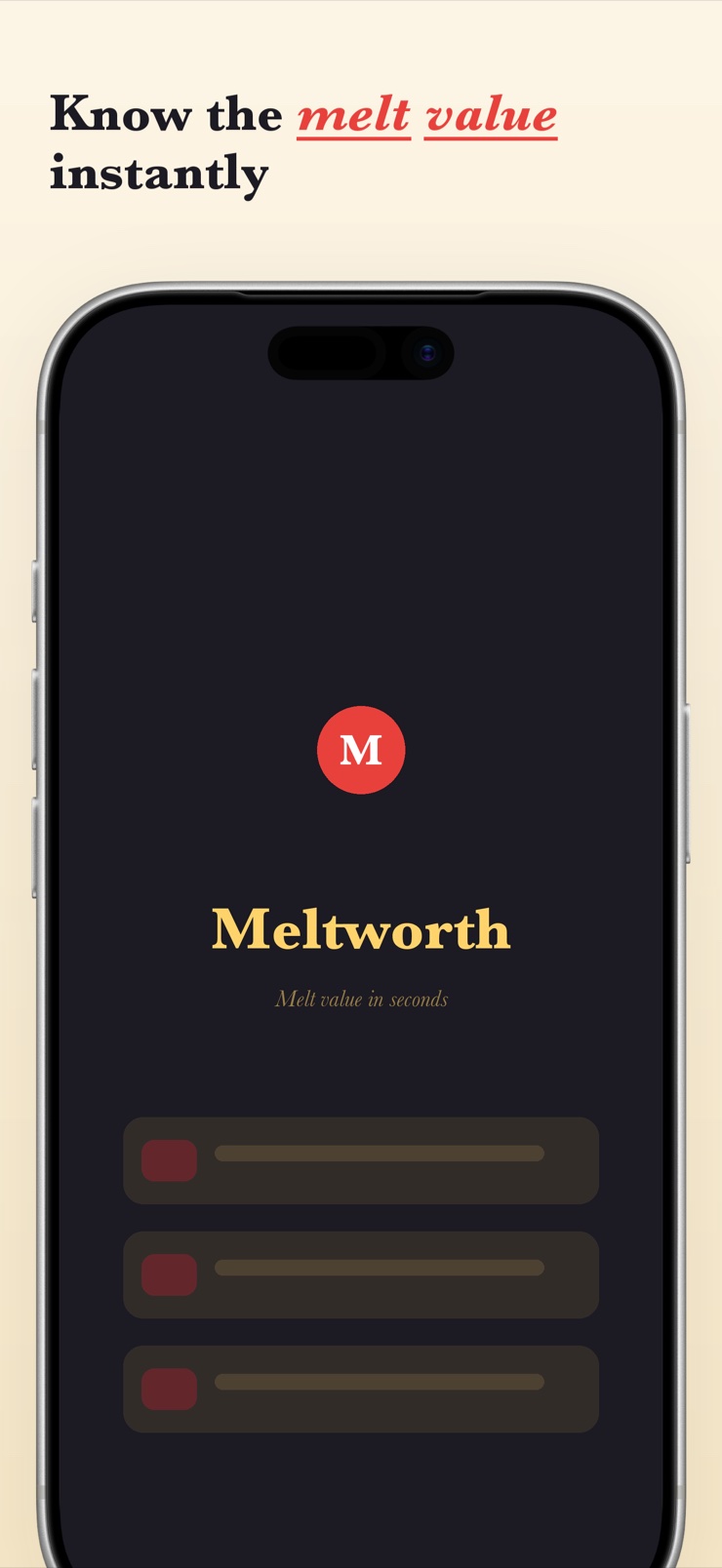
Meltworth is a melt-value calculator for scrap and jewelry metal. Enter the karat or fineness, the weight, and your unit, and it computes what the metal content is worth at the current spot price - for gold, silver, platinum, and palladium.
It is built for the buying counter. Add every piece of a mixed lot as its own row, each with its own metal, purity, and unit, and watch a running grand total update as you go. A payout percentage you set once is applied on top, so you always see both the melt value and your offer.
Spot prices refresh live and are cached on the device, so the calculator keeps working from the last known price when you are offline - always with a visible last-updated stamp. Figures are indicative valuations based on public spot prices, not a buying or selling quote.
Value any purity - 10K, 14K, 18K, 22K, 24K, or direct fineness like .925 and .999 - computed against the live spot price per metal.
Choose grams, pennyweight (DWT), or troy ounces for each row independently. No global unit setting, no side conversions.
Mix gold, silver, platinum, and palladium rows in a single lot and see per-row worth plus a running grand total without switching tabs.
Set your payout percentage once and it stays set across launches, showing your offer and the spread beside the melt value.
Prices fetch live with a clear last-updated stamp. Offline, the calculator falls back to the cached price and says so.
Turn a finished lot into a clean, shareable payout slip listing every row, the melt total, and the offer - ready to print at the counter.
Tell Meltworth what percentage of melt value you pay out. It is stored and applied to every lot until you change it.
Pick the metal, karat or fineness, weight, and unit per row. Per-item worth appears instantly as you type.
The grand total melt value and your payout offer update live as rows are added, edited, or removed.
Export the lot as a text or PDF slip for the customer, your records, or the printer behind the counter.
Melt value is weight times purity times the spot price: a 14K item is 58.3 percent gold, so 10 grams of 14K contains 5.83 grams of pure gold, valued at the current per-gram spot price. Meltworth does this math instantly - you enter karat, weight, and unit, and it applies the live spot price for you.
It changes with the market: 14K is 58.3 percent pure, so its per-gram melt value is 58.3 percent of the pure-gold gram price at that moment. Because spot moves all day, any fixed number goes stale quickly. Meltworth pulls the live spot price and shows the per-gram worth of any karat in real time.
Most buyers start from melt value - weight times purity times spot - and then offer a percentage of it, commonly somewhere between 50 and 90 percent depending on the shop and the item. Meltworth is built around exactly that workflow: it computes the melt value and applies your own payout percentage, showing the offer and the spread side by side.
A pennyweight is a jeweler's unit equal to 1.555 grams, with 20 pennyweight in a troy ounce. Scales at buying counters often read in DWT while sellers think in grams. Meltworth lets each row use grams, DWT, or troy ounces independently, so you never convert by hand.
Fineness expresses purity in parts per thousand: .925 is sterling silver at 92.5 percent pure, and .999 is fine bullion. It is the same idea as karat, just on a different scale - 24K equals .999. Meltworth accepts either notation on any row.
Yes. Meltworth fetches live spot prices for gold, silver, platinum, and palladium and applies them to your entries, with a visible timestamp showing when the price was last updated. When you are offline it keeps working from the cached price and clearly marks it as cached.
Yes. Meltworth handles gold, silver, platinum, and palladium, and lets you mix them in one lot. A sterling flatware row can sit right under an 18K ring row, each valued against its own metal's spot price, all feeding one grand total.
Add each piece as its own row with its metal, purity, weight, and unit, and the per-row worth plus a running grand total update as you go. That one-screen flow is Meltworth's core design - no tab switching and no re-entering your payout percentage between customers.
The math always works offline. Spot prices need a connection to refresh, so offline the app uses the last fetched price and labels the figure as cached with its timestamp. You are never shown a stale number pretending to be live.
No. Melt value is what the pure metal content is worth at spot; buyers pay a percentage below that to cover refining, overhead, and margin. Meltworth shows both numbers explicitly - the melt value and the payout at your configured percentage - so the spread is never hidden.
Yes. Meltworth generates a payout slip listing every row of the lot, the grand-total melt value, and the payout offer, as text or PDF. You can share it, save it for your records, or print it right at the counter.
Yes. Lots and settings, including your payout percentage, are stored locally on the device and are never wiped by an update. There is no account and no server your data depends on.
The melt value, the payout, and the whole lot - on one screen before the customer stops talking.
Coming soon to theApp Store